
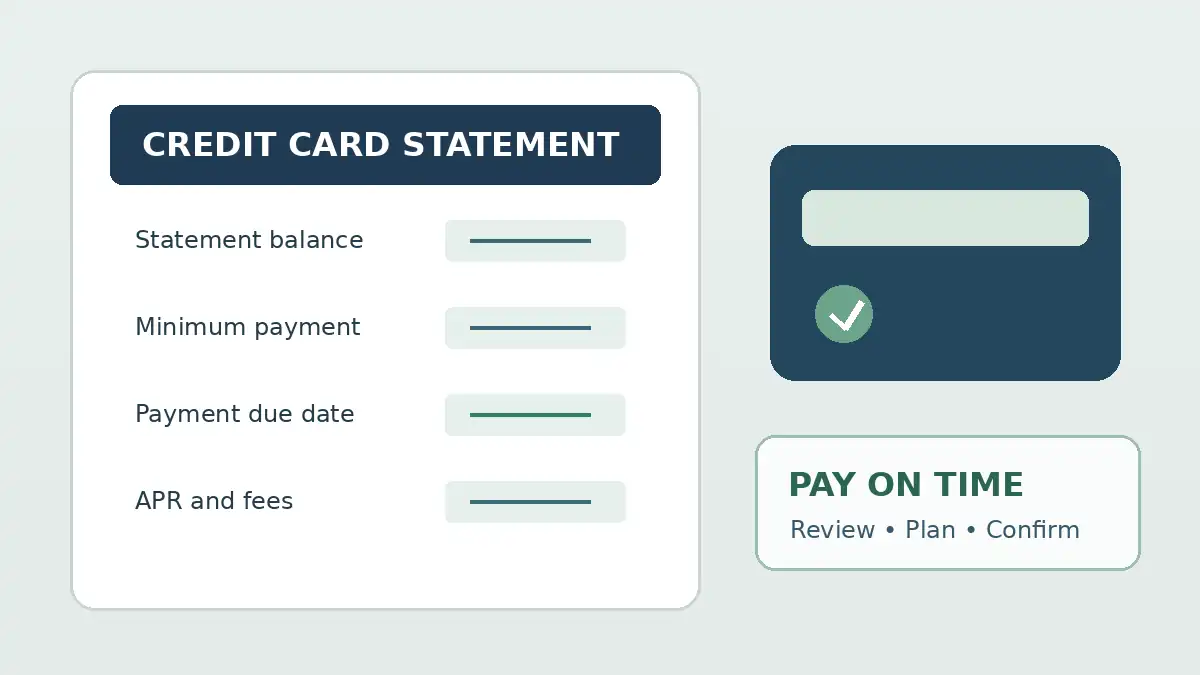
Credit card management starts with understanding what your monthly statement actually asks you to pay. The statement closing date, payment due date, minimum payment, statement balance, and current balance serve different purposes. Confusing them can create avoidable fees or interest even when you believe you are paying regularly.
This U.S.-focused guide explains each figure, walks through a realistic example, and gives you a repeatable monthly review. It is a statement-and-payment guide rather than another generic list of credit card tips. For a broader habits checklist, see our credit card management tips.
Start with five numbers on your statement
Open your most recent statement and find the statement balance, minimum payment, payment due date, annual percentage rate (APR), and credit limit. Record them in one place. The statement balance is the amount billed when the cycle closed; the current balance may include newer transactions and pending adjustments. The minimum is the amount required to keep the account current, not a recommended long-term payoff strategy.
Check the fees and interest section separately. A card may show purchase APR, cash-advance APR, and promotional APR with different terms. Read the actual cardholder agreement rather than assuming every transaction earns a purchase grace period.
| Statement field | What it tells you | Your next action |
|---|---|---|
| Statement balance | Amount billed at cycle close | Plan a full payment if feasible and grace-period terms apply |
| Minimum payment | Required amount for the period | Make sure at least this amount arrives by the due date |
| Due date | Deadline for the issuer to receive payment | Schedule a payment early enough to process |
| Current balance | Balance after newer activity | Use it for monitoring; do not confuse it with the prior statement |
Understand closing date versus payment due date
The closing date ends the billing cycle. The due date is later and is the date by which the issuer must receive at least the required payment. Federal rules generally require credit card statements to be delivered at least 21 days before payment is due. The two dates are not interchangeable, and making a payment on the closing date is not necessarily required.
Suppose a cycle closes on May 3 and your payment is due May 28. New purchases made after May 3 normally appear on the next statement, while the May 3 statement balance remains the amount you review for the May 28 payment. Confirm your issuer’s posted-payment cutoffs and processing time rather than waiting until the last minute.
Work through a statement balance example
Imagine your statement balance is $800, your minimum payment is $35, and you make $150 in new purchases after the cycle closes. Your current balance could be $950 before other adjustments. If your card provides a purchase grace period and you qualify for it, paying the $800 statement balance in full by the due date generally avoids interest on those billed purchases. You do not necessarily need to pay the $950 current balance for that purpose.
If you pay only $35, you meet the minimum payment obligation but may incur purchase interest on the unpaid amount and possibly new purchases, depending on the agreement and whether the grace period has been lost. Paying the minimum is a short-term safety measure, not an interest-free plan. If you have been carrying a balance, residual or trailing interest may appear even after a large payoff.
Know what a grace period does and does not cover
A grace period is an interest-free interval for certain balances when the card agreement’s conditions are met. It often applies to purchases when the prior statement balance is paid in full by the due date, but cash advances and some balance transfers may begin accruing interest immediately. A promotional 0% APR is a different feature, with its own end date and fees.
If you recently carried a balance, check your statement and agreement for how to regain the grace period. Do not assume a single payment resets everything instantly. The CFPB’s credit card definitions explain how terms can vary by agreement.
Estimate interest without treating the estimate as a bill
An APR describes an annualized rate, not a flat monthly fee. As a rough illustration, a constant $1,000 balance at 24% APR would generate about $0.66 per day ($1,000 × 0.24 ÷ 365) before changes in balance or issuer-specific calculation methods. Over 30 days, that simple approximation is about $19.73. Actual interest may differ because issuers typically use daily balances, transaction timing, and different APR buckets.
The right comparison is not just whether you can afford the minimum. Ask how much interest will accumulate and how quickly a fixed extra payment could reduce the balance. Our credit card debt payoff comparison explains avalanche versus snowball approaches when you have more than one balance.
Set up payments with a fallback
Consider automatic payment of the full statement balance when your cash flow can reliably support it. If that would risk an overdraft, automatic minimum payment plus a manually scheduled extra payment can be a safer fallback. Confirm the linked bank account, processing cutoff, payment method, and whether the issuer permits you to change the due date.
- Set an alert five days before the due date and another when payment posts.
- Verify the statement amount and cash available before an automatic full payment.
- Keep a small checking buffer for pending transactions and irregular bills.
- If a payment fails or a fee appears, contact the issuer promptly and document the resolution.
Federal rules govern when a payment can be considered late, but a practical plan leaves room for weekends, holidays, bank processing and human error. See the CFPB guidance on payment deadlines.
Review transactions, fees, and unusual activity
Scan every transaction against receipts or your expense log. Look for recurring subscriptions, duplicate charges, refunds that have not posted, cash-advance fees, annual fees, foreign transaction fees, and unexpected APR changes. A merchant descriptor may be unfamiliar even when the purchase is yours; verify before filing a dispute.
Turn on transaction notifications and review statements monthly. For identity-related concerns, our credit monitoring versus credit freeze guide explains what those tools do and do not prevent. Review your credit reports through authorized channels; statement monitoring alone does not replace credit-report checks.
Keep utilization in perspective
Credit utilization compares revolving balances with available credit limits. A $1,500 reported balance against a $5,000 limit is 30% utilization. This is a useful calculation, not a universal magic threshold that guarantees a score. Different scoring models and reporting dates can produce different outcomes. Focus first on timely payments, affordable balances, and avoiding expensive interest.
If you are starting from little or no credit history, see our build credit from scratch plan. Do not open additional cards simply to chase a short-term score change without considering fees and the risk of overspending.
Create a ten-minute monthly review
- Download the statement and record its closing date, due date, balance, minimum, and APR.
- Compare posted transactions and fees against your budget; flag unfamiliar charges.
- Choose a payment amount that is realistic, with a minimum-payment safety net.
- Schedule payment and confirm that it posts before the deadline.
- Update your debt payoff or spending plan for the next cycle.
A simple tracker can use five columns: card name, due date, statement balance, planned payment, and confirmation date. If you manage several cards, group due dates on one calendar rather than relying on memory. Use our weekly budget reset to coordinate card payments with rent, groceries, and irregular expenses.
When to ask for help or change strategy
If you cannot make the minimum, contact the issuer before the deadline and ask about hardship options. A nonprofit credit counselor may help you review a budget and payment alternatives. Be cautious of anyone promising to erase legitimate debt or demanding large upfront fees. The debt consolidation comparison outlines how to compare total costs and alternatives.
The goal is not to maximize rewards or juggle the most cards. It is to know what you owe, understand the terms, prevent missed payments, and reduce avoidable interest while keeping everyday spending within a sustainable plan.
Frequently asked questions
Should I pay the statement balance or the current balance?
For a card with a qualifying purchase grace period, paying the full statement balance by the due date generally avoids interest on billed purchases. The current balance includes later transactions. Check your agreement and whether you previously carried a balance.
Is paying the minimum enough?
It usually satisfies the required periodic payment if received on time, but interest may continue and repayment can take much longer. Pay more when feasible, and use the issuer’s minimum-payment warning as a planning aid.
Does the statement closing date equal the payment due date?
No. The closing date ends a billing cycle; the due date comes later and governs when the required payment must be received.
Why did I get interest after paying off the card?
Residual or trailing interest can arise when a balance was carried before the payoff. Ask your issuer how interest accrued and what is needed to restore any purchase grace period.
Will keeping utilization under 30% guarantee a good credit score?
No. Utilization is one factor and 30% is not a guaranteed score threshold. Timely payments, affordable borrowing and the full credit profile matter.
Sources and further reading
- CFPB: Know Before You Owe — credit cards — payment, interest and agreement basics
- CFPB: When is a credit card payment late? — payment receipt and cutoff rules
- CFPB Regulation Z §1026.7 — periodic statement requirements
- CFPB: Credit card contract definitions — grace period and account terms